Inflation Impact on Savings 2026: Why Your Bank Account is a Leaking Bucket
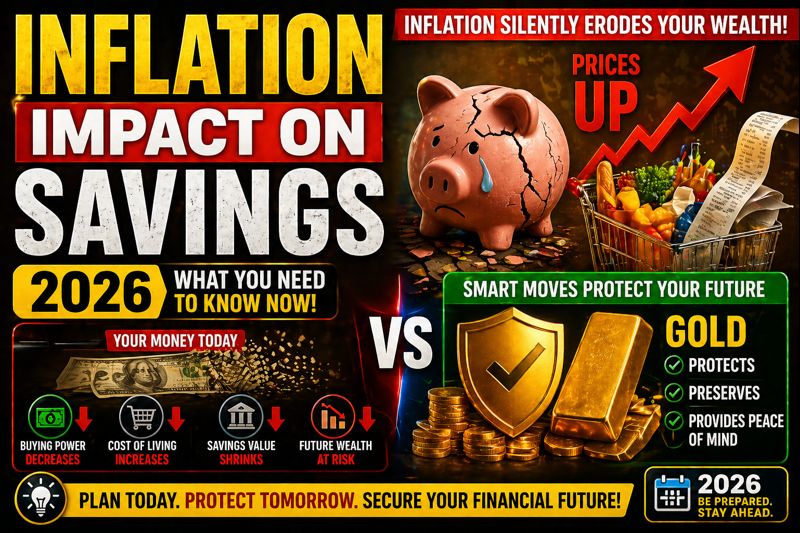
If you have $100,000 sitting in a high-yield savings account this April, you might feel secure. Your bank statement shows the numbers going up slightly every month. But there is a massive problem: the numbers are growing, but the value is shrinking. In April 2026, we are witnessing a “bifurcated inflation” event. While the Federal Reserve claims inflation is “moving toward 2%,” the prices for things you actually need—energy, healthcare, and insurance—are skyrocketing at nearly double-digit rates. This is the inflation impact on savings in 2026, and it’s acting like a silent tax on your retirement.
1. The “Real-World” vs. “Official” Inflation Gap
The biggest trap for investors in 2026 is believing the headline CPI.
- The Official Number: 2.4% – 4.6% (depending on the month and volatile energy costs).
- The Real-World Cost: Medical trends are up 11.5%, and urban lifestyle costs are rising at 8–10%.
- The Result: If your bank pays you 4% interest, but your cost of living goes up 10%, you didn’t “earn” 4%. You lost 6% of your ability to buy goods and services.
2. The Purchasing Power Death Spiral
To understand the inflation impact on savings in 2026, look at the US dollar’s purchasing power compared to 2023. Due to the cumulative effect of the last few years, $1.00 in 2023 is roughly worth only $0.82 today in terms of actual utility. If you haven’t moved into “hard assets,” your retirement timeline just got pushed back by several years without you even spending a dime.
3. Why Banks Can’t (And Won’t) Save You
In mid-2026, central banks are in a “Goldilocks” trap. They want to keep interest rates low to support a cooling labor market, but they need them high to fight inflation.
- The Squeeze: This means deposit rates remain “sticky.” Banks are slow to pass on higher rates to you, but fast to charge them on your loans.
- The Reality: Your savings account is essentially a “loan” you are giving the bank at a loss.
[Image showing a dollar bill dissolving into sand while a gold coin remains solid]
4. The Gold “Hard Asset” Pivot
This is exactly why gold performance 2026 is breaking records. Gold is the ultimate “anti-dollar.” It cannot be digitally issued or diluted by central bank policy.
- The Hedge: While $10,000 in a bank account buys less every year, that same $10,000 in physical gold has historically maintained its “weight” in terms of purchasing power.
- 2026 Strategy: Experts recommend moving at least 15–20% of liquid savings into a Gold IRA to act as a “Wealth Insurance Policy” against this 8% silent theft.
Also read this: Ready to stop the leak? Read our guide on Is a Gold IRA a Good Investment? to see how physical assets protect your “Real Value” better than a bank account.
🛡️ Stop the Silent Theft of Your Retirement
Your bank won’t tell you that your money is worth 8% less than last year. We will.
Get the “2026 FREE Wealth Protection” Kit Learn the “Hidden Inflation” math they don’t teach in schools and see why physical gold is the only asset that doesn’t have a “delete” button.
Analyzing the Inflation Impact on Savings in 2026
The inflation impact on savings in 2026 is becoming the greatest threat to long-term wealth preservation. While traditional bank accounts offer a sense of security, the current inflation impact on savings in 2026 means that every dollar held in cash is losing its real-world utility. Because the cost of living is rising at 8%, the inflation impact on savings in 2026 essentially functions as an invisible withdrawal from your retirement fund. If you do not account for this inflation impact on savings in 2026, your projected nest egg may only buy half of what you planned for when you eventually stop working.
Conclusion: Cash is No Longer King
In the 2026 economic landscape, holding too much cash is a high-risk strategy. The inflation impact on savings in 2026 is real, and it is aggressive. To survive this “Silent Depression,” you must shift from a “saving” mindset to an “ownership” mindset. Whether it’s gold, silver, or real estate, owning physical things is the only way to ensure your future self can still afford the life you’re working for today.