Gold Price Indecision 2026: Why Gold is Sideways at $4,600?
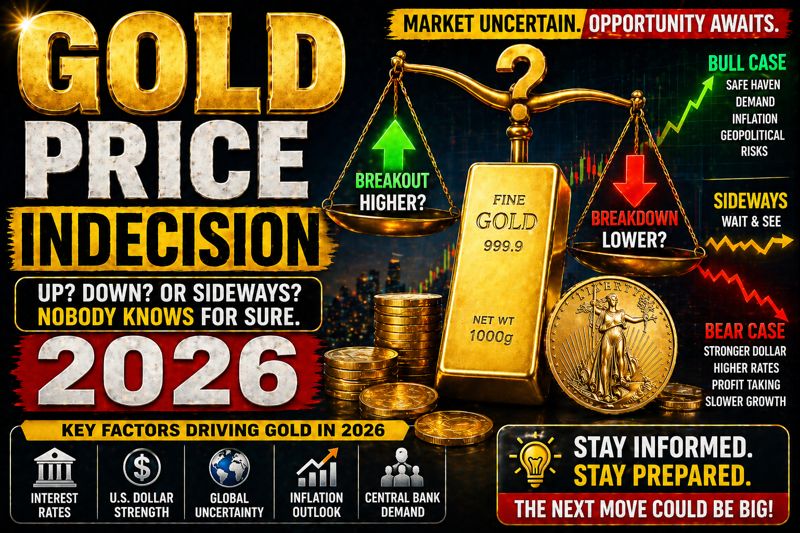
Have you noticed the current Gold Price Indecision 2026 causing the markets to hold their collective breath? While gold has recently stabilized near the $4,600 support level, many US investors are feeling the weight of this sideways trend. This Gold Price Indecision 2026 isn’t just a random stall; it is a strategic consolidation phase driven by shifting US Treasury yields and institutional banking liquidity. Understanding this period of market hesitation is essential for anyone looking to protect their retirement portfolio from upcoming volatility.
For the average retiree watching their 401(k), this “indecision” can be more nerve-wracking than a price drop. But for the seasoned investor, this isn’t just a stall—it’s a high-stakes chess match between US Treasury yields, banking liquidity, and global demand. Let’s dive into why the banks are hesitating and why $4,600 might just be the most important number for your retirement portfolio this quarter. 🧐
🏗️ The $4,600 Support Level: A Floor Built of Central Bank Bricks
When we talk about “Gold Price Indecision 2026,” we have to look at the floor before we look at the ceiling. Despite a cooling of immediate geopolitical tensions in the Middle East, gold refuses to drop below $4,600. Why? 🧱
The Institutional Safety Net
Major institutions and central banks are no longer just “trading” gold; they are using it as a foundational reserve. Every time the price dips toward $4,580, we see massive buy orders triggered. This isn’t retail FOMO—this is institutional accumulation. They view $4,600 as the “fair value” in a world where the US Dollar is facing long-term structural shifts.
Consolidation vs. Distribution
In technical terms, we are in a Consolidation Phase. Think of it like a spring being compressed. The longer the price moves sideways within a tight range, the more explosive the eventually move tends to be. Since we are holding firm above $4,600, the technical bias remains heavily toward a breakout to the upside.
⚖️ The Yield Tug-of-War: US Treasuries vs. Tangible Assets
The biggest driver of the current “banking indecision” is the volatility in US Treasury Yields. In April 2026, the 10-year yield is hovering around 4.3%, creating a tug-of-war for investor capital. 🧶
Why Yields Matter to Your Gold IRA
Gold is a non-yielding asset. When government bonds offer high “risk-free” returns, institutional money often flows out of gold and into paper. However, with 2026 inflation still sticky at 3.3%, that “risk-free” return is actually much lower when adjusted for purchasing power.
The “Neutral Zone” Dilemma
Currently, the market is in a “Neutral Zone.” The Fed is signaling a pause, the DXY (Dollar Index) is stagnant at 99.8, and investors are waiting for a clear signal. This lack of direction is exactly what leads to the sideways price action we’re seeing today. 🚦
Pro Tip: Before committing to a large purchase, check out our Best Gold IRA Companies 2026 review to see which custodians are offering the best buyback spreads during this period of consolidation.
🌍 Global Macro Drivers: The Islamabad Factor and Beyond
While the news cycle has stabilized slightly following the Islamabad talks, the “Safe Haven” demand for gold hasn’t vanished—it’s just transformed. 🕊️
The Fragile Ceasefire
The ceasefire between US-backed interests and regional powers has taken the “war premium” out of the gold price. This is why we saw the drop from the $4,749 highs back to the $4,600 support. However, smart money knows that a ceasefire is not a solution. The underlying debt issues and currency devaluations that fueled the initial rally are still very much alive.
De-Dollarization is a Marathon, Not a Sprint
Even during periods of “Gold Price Indecision 2026,” the long-term trend of de-dollarization continues. Central banks in the East are still converting their paper reserves into physical bullion. They aren’t worried about whether gold is $4,600 or $4,700 today; they are worried about where the dollar will be in 2030. 🏃♂️💨

🛡️ How to Play the Sideways Market: Strategy for US Investors
So, if you’re sitting on the sidelines watching gold move back and forth by $20 every day, what should you do? 🤷♂️
1. Dollar-Cost Averaging (DCA)
Don’t try to time the “perfect” breakout. Sideways markets are the ideal time for DCA. By adding to your position at $4,600, you are building a solid cost basis before the next major market catalyst drives prices toward the $5,000 target.
2. Focus on “IRS-Approved” Quality
During consolidation, liquidity is king. Ensure that any gold you add to your SDIRA meets the strict 0.995+ fineness requirements. To avoid the most common pitfalls, read our guide on IRS-Approved Gold Coins for 2026. 🪙
3. Watch the $4,550 “Trap”
If gold breaks below $4,600, look for a quick dip to $4,550. This is often a “liquidity grab” where big players shake out small investors before a massive rally. If we hit $4,550 and bounce quickly, it’s a strong signal that the bulls are still in control.
🔮 Final Thought: The Calm Before the Q3 Storm?
The current banking indecision isn’t a sign of weakness—it’s a sign of preparation. History shows that gold rarely stays quiet for long, especially when the fundamental pillars of the global economy are shifting. 🌪️
Whether the next catalyst is a shift in Fed policy, a flare-up in geopolitical tensions, or another jump in CPI data, the $4,600 support level is your line in the sand. For the patient investor, this sideways market is a gift—a rare chance to secure physical wealth at a stable price before the 2026 rally resumes.
Are you ready to anchor your retirement? Don’t let the banking indecision paralyze your planning. Secure your physical gold today and turn this period of consolidation into your greatest financial advantage. ⚓✨