Silver in AI Technology 2026: Why High-Performance Computing is Squeezing Global Supply
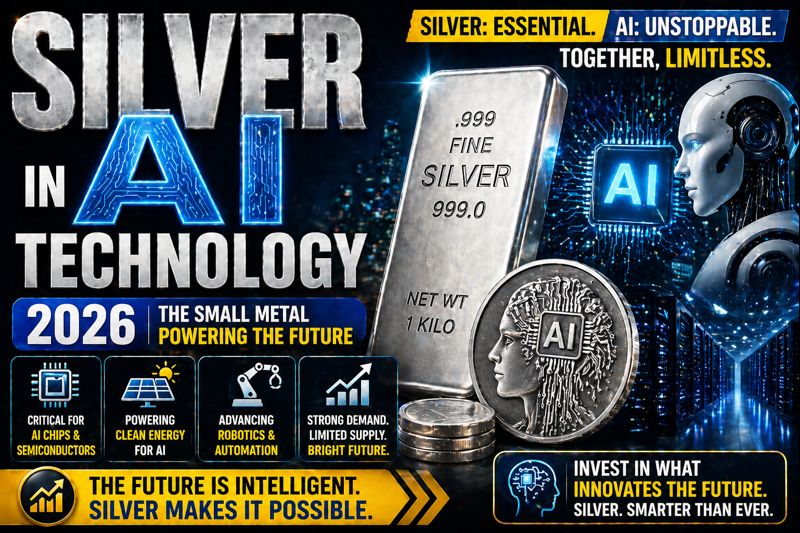
The role of Silver in AI Technology 2026 has shifted from a marginal industrial component to a critical strategic bottleneck as the global race for computational supremacy accelerates. While traditional sectors like jewelry are seeing a decline due to record-high prices, the integration of Silver in AI Technology 2026 is expanding rapidly within the high-density processors and thermal management systems required for machine learning. This surge in high-performance computing demand, combined with a projected 67-million-ounce global deficit, has established a new “industrial floor” for silver prices that bypasses typical retail volatility. For retirement investors, understanding the fundamental physics of Silver in AI Technology 2026 is essential for recognizing why physical silver is no longer just “the poor man’s gold,” but a tech-essential asset for any Gold IRA rollover.
1. The Physics of Performance: Why AI Needs Silver
In the world of high-performance computing (HPC), electrical resistance is the enemy. Silver in AI Technology 2026 is utilized primarily because it possesses the highest electrical conductivity of any element on the periodic table ($63.0 \times 10^6$ S/m).
Conductivity and Signal Integrity
As AI models become more complex, the density of transistors on a single chip increases the risk of signal degradation. Silver in AI Technology 2026 is the preferred material for the high-frequency conductive inks and die-attach materials that connect advanced GPUs. Unlike copper, which can oxidize and increase surface resistance over millions of switching cycles, silver remains stable. This 6% conductivity advantage over copper—while seemingly small—translates to a 15-25% improvement in data throughput for the massive server clusters owned by companies like NVIDIA and Microsoft.
Thermal Management in GPU Clusters
AI processors generate heat loads that exceed conventional computing by orders of magnitude. Silver in AI Technology 2026 plays a starring role here due to its thermal conductivity of 429 W/m·K. Silver-loaded thermal interface materials (TIMs) enable these systems to dissipate heat 7% more efficiently than copper alternatives. In a data center environment where cooling costs can account for 40% of operational expenses, the efficiency of Silver in AI Technology 2026 is a purely economic necessity for hyperscalers.
2. The Solar vs. AI Tug-of-War
For years, the solar industry was the primary driver of industrial silver demand. However, as we move through April 2026, a fascinating shift is occurring.
- The Solar Pivot: High prices have forced solar manufacturers to “thrift” or substitute silver with copper in their panels.
- The AI Absorption: While solar demand is projected to soften by 7% this year, the demand for Silver in AI Technology 2026 and data center infrastructure is absorbing that surplus.
Because the cost of silver represents less than 0.1% of the total value of a $40,000 AI server, tech manufacturers are “price inelastic.” They will continue to buy Silver in AI Technology 2026 regardless of whether it is $30 or $100 an ounce, because the performance failure of a multi-billion dollar training run is far more expensive than the metal itself.
3. Structural Supply Deficits and the “Sixth Year”
According to the Silver Institute’s 2026 forecast, the market is heading for its sixth consecutive annual deficit.
Inelastic Mining Output
A common misconception is that higher prices will lead to an immediate spike in silver mining. In reality, nearly 70% of silver is mined as a by-product of lead, zinc, and copper mining. Therefore, even if the demand for Silver in AI Technology 2026 skyrockets, miners cannot simply “turn on the tap” without also increasing the production of base metals. This supply rigidity ensures that the squeeze remains tight throughout the 2026 fiscal year.
Recycling and the 200 Million Ounce Mark
While recycling is expected to hit a decade-high of 200 million ounces this year, it is not enough to bridge the gap. Much of the Silver in AI Technology 2026 is used in such small, complex quantities within semiconductors that it is currently not economically viable to recover. This means that a significant portion of industrial silver is “consumed” rather than just “used,” removing it from the global supply permanently.

4. Why This Matters for Your Gold IRA
If you are currently evaluating how to start a gold IRA, the data surrounding Silver in AI Technology 2026 provides a compelling case for a diversified “Precious Metals IRA.”
- The 20% Silver Rule: By allocating 20% of your portfolio to silver, you are effectively investing in the infrastructure of the Fourth Industrial Revolution.
- Hedge Against “Paper” Volatility: While the stock market may fluctuate based on interest rates, the physical demand for Silver in AI Technology 2026 is tied to the physical build-out of the internet’s next iteration.
🛑 WATCH FOR SCAMS: As industrial demand grows, some dealers may try to sell you “rare” silver coins with high premiums. Always focus on 0.999 fine bullion to ensure your investment tracks the industrial spot price.
Get the “Free Silver Scheme” Watchdog Report – Protect your 2026 rollover from marketing traps.
Conclusion: The Future of the Silver Squeeze
The story of Silver in AI Technology 2026 is one of physical limits meeting digital ambition. As we look toward the second half of 2026, the $81 average price forecast from major institutions like J.P. Morgan seems increasingly conservative. Between the Solar Boom and the AI Hardware Squeeze, silver has transitioned from a speculative asset to a strategic industrial necessity.
By securing physical silver today within a Self-Directed IRA (SDIRA), you aren’t just betting on a metal—you’re betting on the physical foundation of the AI era.