401(k) to Gold IRA Rollover Guide 2026: Step-by-Step
If you are worried about inflation, stock market volatility, or protecting your retirement savings, a 401(k) to Gold IRA rollover may be one strategy worth understanding in 2026.
A 401(k) to Gold IRA rollover allows eligible investors to move retirement funds from an old employer-sponsored 401(k) account into a self-directed Gold IRA. This type of account can hold IRS-approved physical gold, silver, and other precious metals.
In this detailed guide, we’ll explain how a 401(k) to Gold IRA rollover works, the rules you need to know, common mistakes to avoid, possible fees, and how to choose the right Gold IRA company.
What Is a 401(k) to Gold IRA Rollover?
A 401(k) to Gold IRA rollover is the process of transferring funds from a 401(k) retirement account into a self-directed IRA that allows physical precious metals.
Most regular IRAs and 401(k) plans do not allow direct ownership of physical gold. A self-directed Gold IRA gives investors more control and allows investment in approved precious metals stored in an IRS-approved depository.
This rollover is commonly used by investors who want to:
- Reduce exposure to stock market volatility
- Diversify retirement savings
- Protect purchasing power from inflation
- Add physical gold to a long-term retirement plan
- Move old employer 401(k) funds into a more flexible account
Why Investors Consider a 401(k) to Gold IRA Rollover in 2026
Many retirement investors are looking for alternatives because economic uncertainty remains a major concern. Stocks can rise over the long term, but they can also fall sharply during recessions, financial crises, or inflationary periods.
A 401(k) to Gold IRA rollover may appeal to investors who want part of their retirement savings backed by physical assets instead of only paper assets.
1. Inflation Protection
Gold has historically been viewed as a hedge against inflation. When the value of paper currency declines, gold often becomes more attractive because it cannot be printed like money.
2. Portfolio Diversification
Diversification means not putting all your retirement savings into one type of asset. A Gold IRA can help balance a portfolio that may already include stocks, bonds, mutual funds, or index funds.
3. Retirement Wealth Preservation
Gold is often used more for wealth preservation than aggressive growth. For retirees and near-retirees, protecting existing savings can be just as important as chasing higher returns.
4. More Control Over Retirement Assets
A self-directed Gold IRA gives investors more control over what they hold inside their retirement account, including eligible gold coins, bars, silver, platinum, and palladium.
Who Is Eligible for a 401(k) to Gold IRA Rollover?
Not every 401(k) can be rolled over immediately. Eligibility depends on your employment status and plan rules.
You May Be Eligible If:
- You have an old 401(k) from a previous employer
- You are retired
- You changed jobs
- Your current employer plan allows in-service rollovers
- You have another eligible retirement account that can be transferred
If your 401(k) is with your current employer, check whether your plan allows an in-service withdrawal or rollover. Some plans allow this after a certain age, while others do not.
How Does a 401(k) to Gold IRA Rollover Work?
The process is usually straightforward when done correctly. The safest method is usually a direct rollover, where funds move from one custodian to another without you personally receiving the money.
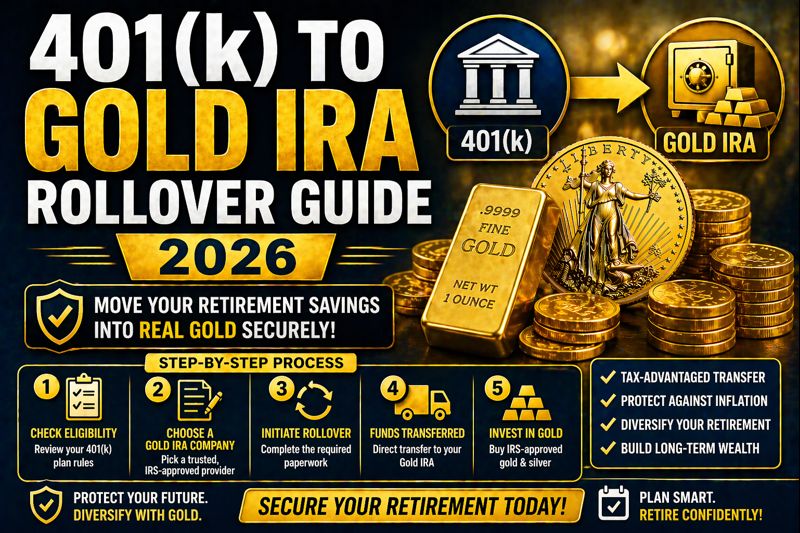
Step 1: Choose a Trusted Gold IRA Company
The first step is selecting a Gold IRA provider that can help you open a self-directed IRA and coordinate the rollover process.
Before choosing a company, compare reputation, fees, customer support, rollover experience, and educational resources.
Helpful guide: Best Gold IRA Companies 2026
Step 2: Open a Self-Directed Gold IRA
You need a self-directed IRA because standard retirement accounts usually do not allow physical gold ownership. The new account must be set up properly before the funds are transferred.
Step 3: Request a Direct Rollover
A direct rollover moves money directly from your 401(k) plan to your new Gold IRA custodian. This helps avoid taxes, penalties, and mistakes related to the 60-day rollover rule.
Step 4: Fund the Gold IRA
Once the rollover is approved, funds are transferred into your self-directed IRA. The timeline may vary depending on your old 401(k) provider and the new custodian.
Step 5: Buy IRS-Approved Gold
After the funds arrive, you can purchase eligible precious metals. The gold must meet IRS purity standards and must be stored in an approved depository.
💡 Smart investors are already protecting their savings with Gold IRAs.
This free guide explains how to safely move your retirement funds step-by-step.
👉 Download Free Gold IRA Guide NowDirect vs Indirect 401(k) to Gold IRA Rollover
There are two main rollover methods: direct and indirect.
Direct Rollover
A direct rollover is when funds move directly from your 401(k) plan to your Gold IRA custodian. This is generally the preferred method because it reduces tax risk.
- Lower chance of penalties
- No personal handling of funds
- Simpler for most investors
- Better for compliance
Indirect Rollover
An indirect rollover is when the money is sent to you first, and you must deposit it into the new IRA within 60 days. If you miss the deadline, the IRS may treat it as a taxable distribution.
- Higher risk of mistakes
- 60-day deadline applies
- Possible tax withholding issues
- Not ideal for beginners
For most retirement investors, a direct 401(k) to Gold IRA rollover is usually the safer route.
IRS Rules for a 401(k) to Gold IRA Rollover
A Gold IRA must follow IRS rules. Breaking these rules can lead to taxes, penalties, or account problems.
1. Gold Must Meet Purity Standards
Most gold held in an IRA must meet a minimum purity standard of 99.5%. Certain approved coins and bullion are allowed.
2. Metals Must Be Stored in an Approved Depository
You cannot personally store Gold IRA metals at home. The gold must be held by an IRS-approved depository through your custodian.
3. Avoid Prohibited Transactions
You cannot personally use, pledge, borrow against, or take possession of IRA-owned gold before a qualified distribution.
4. Required Minimum Distributions May Apply
If you hold a traditional Gold IRA, required minimum distribution rules may apply later in retirement.
Related guide: Gold IRA Tax Rules 2026
401(k) to Gold IRA Rollover Fees
A 401(k) to Gold IRA rollover may involve several types of fees. Understanding these costs before investing is important.
Common Gold IRA Fees Include:
- Account setup fee
- Annual custodian fee
- Storage fee
- Wire transfer fee
- Dealer markup or spread
- Possible account closing fee
Fees vary by company, custodian, depository, and investment amount. Always request a clear fee breakdown before opening an account.
Full breakdown: Gold IRA Fees Explained 2026
Pros and Cons of a 401(k) to Gold IRA Rollover
Pros
- Helps diversify retirement savings
- Provides exposure to physical gold
- May protect against inflation
- Can reduce dependence on stock market performance
- Offers tax-advantaged retirement structure
Cons
- Gold does not pay dividends
- Storage and custodian fees apply
- Gold prices can fluctuate
- Not ideal for short-term investing
- Requires careful compliance with IRS rules

How Much of Your 401(k) Should You Roll Over to Gold?
There is no perfect amount for everyone. The right allocation depends on age, retirement goals, risk tolerance, and overall portfolio size.
Some investors choose a smaller allocation for diversification, while others increase gold exposure during uncertain economic conditions.
Common Allocation Ranges
- 5%–10%: Conservative diversification
- 10%–20%: Balanced retirement protection
- 20%–30%: Higher inflation or market crash concern
Most investors should avoid moving 100% of retirement savings into gold. A 401(k) to Gold IRA rollover works best as part of a diversified plan.
Common 401(k) to Gold IRA Rollover Mistakes
1. Using an Indirect Rollover Without Understanding the Rules
Missing the 60-day deadline can trigger taxes and penalties.
2. Choosing a Company Based Only on Ads
Always compare reviews, fees, support, and transparency before choosing a provider.
3. Ignoring Storage Rules
Home storage can create serious IRS issues if not handled correctly.
4. Buying Non-Approved Metals
Not every gold coin or bar qualifies for a Gold IRA.
5. Rolling Over Too Much at Once
Over-allocating to gold can reduce growth potential and liquidity.
Best Type of Gold for a Gold IRA
The best gold for a Gold IRA is IRS-approved, liquid, recognizable, and easy to value.
Common Approved Options May Include:
- American Gold Eagle coins
- Canadian Gold Maple Leaf coins
- Approved gold bars
- Other eligible bullion meeting IRS standards
Your Gold IRA company and custodian should help confirm whether a product is eligible before purchase.
401(k) to Gold IRA Rollover vs Keeping Your 401(k)
| Feature | 401(k) | Gold IRA |
|---|---|---|
| Asset Type | Stocks, bonds, funds | Physical precious metals |
| Inflation Protection | Depends on holdings | Often stronger |
| Control | Limited by plan | More investment flexibility |
| Storage | Not applicable | Approved depository required |
| Best For | Growth-focused investors | Diversification and protection |
Who Should Consider a 401(k) to Gold IRA Rollover?
A 401(k) to Gold IRA rollover may be worth considering if you:
- Have an old 401(k) from a previous employer
- Want to diversify beyond stocks and bonds
- Are concerned about inflation
- Prefer physical assets inside retirement savings
- Want long-term wealth preservation
It may not be ideal if you need short-term liquidity, want dividend income, or are uncomfortable with storage and custodian fees.
Final Thoughts: Is a 401(k) to Gold IRA Rollover Worth It in 2026?
A 401(k) to Gold IRA rollover can be a useful strategy for investors who want retirement diversification, inflation protection, and exposure to physical gold.
However, it should not be done blindly. You need to understand fees, IRS rules, storage requirements, and proper allocation before making a decision.
The smartest approach is to compare trusted Gold IRA companies, review the costs, and use gold as one part of a balanced retirement strategy.
If done correctly, a 401(k) to Gold IRA rollover can help protect your retirement savings and reduce reliance on traditional paper assets.
FAQs About 401(k) to Gold IRA Rollover
Can I roll over my 401(k) into a Gold IRA?
Yes, many eligible 401(k) accounts can be rolled over into a self-directed Gold IRA, especially if the account is from a previous employer.
Is a 401(k) to Gold IRA rollover taxable?
A direct rollover is generally not taxable when done correctly. Taxes may apply if the rollover is mishandled or treated as a distribution.
How long does a 401(k) to Gold IRA rollover take?
The process may take a few days to a few weeks depending on the 401(k) provider, custodian, paperwork, and funding process.
Can I store Gold IRA metals at home?
No, IRA-owned gold must usually be stored in an approved depository through a qualified custodian.
How much should I roll over into gold?
Many investors consider 10%–20% for diversification, but the right amount depends on your personal financial goals and risk tolerance.